UK Research and Innovation (UKRI) has announced the launch of phase two of its application window for funding for “Gambling Harms Research and Innovation Partnerships”.
UKRI is the chief commissioner for research under the new structure of the Statutory Levy on Gambling Harms, in effect since 6 April 2025. The levy’s framework allocates 20% of proceeds to UKRI to oversee research-related projects, studies and partnerships.
Research is fed back to the NHS to inform its development of treatment and support for problem gambling, and to the Gambling Commission to inform its governance of UK gambling licences.
UKRI has budgeted for £50m in guaranteed funding from levy contributions, with total levy funding projected to reach £120m by the end of March 2026.
Phase one of UKRI’s gambling harms research funding programme was launched on 14 May 2026. It was branded as “the UK’s largest independent gambling harms research centre”.
Phase two applications must be submitted by 29 April 2027. Successful partnerships are expected to start by 30 September 2027 and run for up to four years.
UKRI maintains its objective of funding “world class research to address gambling harms”.
Gambling “Evidence Centre’ underway
UKRI has recognised problem gambling as a social disorder, with the cost to the UK economy “conservatively estimated at around £1.4bn per year”.
A key objective is for UKRI to establish an “Evidence Centre”, which will be supported by the universities of Glasgow, Sheffield and Swansea, as well as King’s College London.
The institutions will play a strategic role in “exploring how UKRI and other data assets can support generating new evidence” and will help “coordinate the cohort of GHR-UK Innovation Partnerships”.
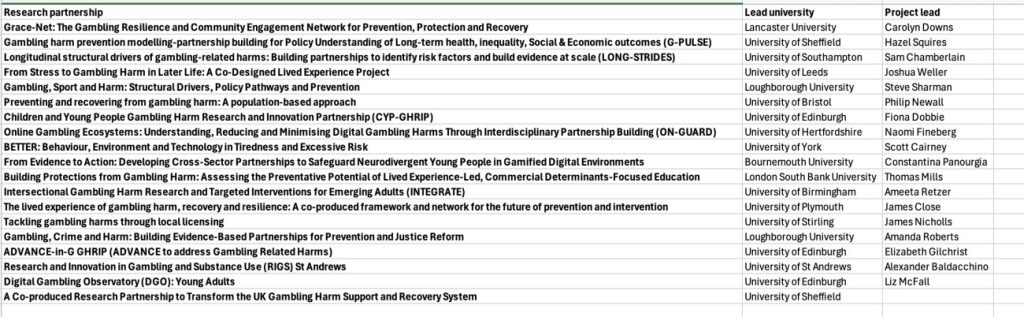
In phase one of the funding programme, UKRI approved applications from 19 partnerships and projects, each supported by an academic or university steward.
The projects and partnerships that qualified in phase one demonstrated a deep understanding of the disciplines and intricacies involved in researching gambling harm behaviours, trends and discrepancies.
UKRI states that the 19 approved phase one applications provided credible plans to widen the scope of evidence-led research into gambling harms and their impacts in the chosen fields.
The programmes that qualified for phase two had identified ‘evidence gaps’ in existing research and data. They also involved people with lived experience of gambling harms and addiction more closely through “dialogue and co-creation with stakeholders and lived experience participants”.
As such, those that qualified were deemed to have demonstrated “landscape and evidence analysis to build the evidence base for the phase two application”.
Beyond design
Launched this morning, phase two is viewed by UKRI and its partners as the “delivery stage”, in which they will examine how programmes build on the groundwork laid in their initial applications.
Evaluations will focus on how applicants will transform their initial designs into fully funded projects in key areas of research. “During phase two you must build upon partnerships, design and deliver research, evidence, data, and expertise to take advantage of opportunities and find solutions to tackle gambling harms within your thematic area.”
The teams behind the 19 applications approved in phase one will be granted a year to build out their research proposals for funding from UKRI’s £50m pool. The focus will be on gathering evidence, reviewing data and developing research with people who have lived experience of gambling harms.
Projects must ensure that their research builds unique datasets and produces evidence that can inform policy and the wider network working on gambling harms.
£5m projects
In phase two, UKRI will select between six and ten partnerships through a second competition, looking for teams that can “deliver insights and solutions tailored to the most pressing issues caused by gambling harm”.
A key condition concerns impact, which “can be defined as the long-term intended or unintended effect research and innovation has on society, economy and the environment; to individuals, organisations, and the wider global population.”
Qualifying programmes can apply for funding of up to £5m. UKRI expects to select and fund projects and programmes from September 2025.
“The full-economic-costing of your phase one project can be up to £5 million. UKRI will fund 80% of the FEC. UKRI will fund up to 10 phase two awards for four years. All applicants successful at phase one are invited to submit an application for phase two.
“Awards at phase two will be made at 80% FEC, and the research organisation must agree to find the balance of full economic cost from other resources.”
The selected teams will work with the Gambling Harms Research Evidence Centre and people with lived experience to fill gaps in the evidence and inform policies and interventions to reduce gambling harms.