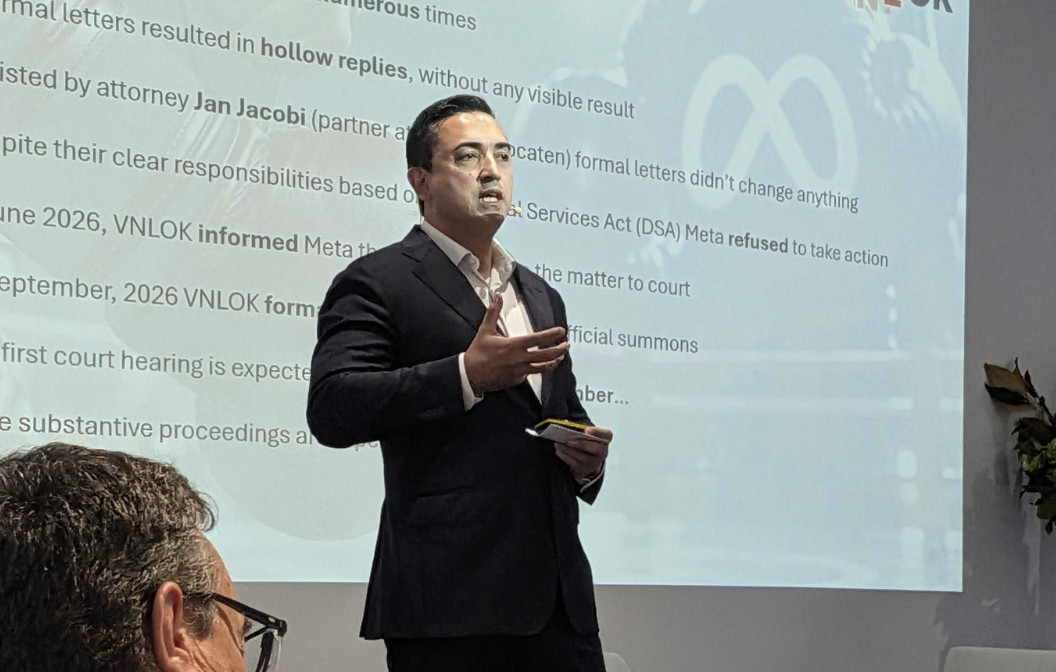
At the Gaming in Spain Conference, VNLOK chairman Björn Fuchs states that the trade body has the clear cut evidence on Meta’s system of failures that have allowed audiences to be lured by illegal gambling content… A Dutch challenge that will have consequences across all European markets.
Dutch betting trade body VNLOK will push forward with its seismic challenge against tech giant Meta over alleged failures to protect audiences in the Netherlands from engaging with the illegal gambling advertising and promotions.
In his role as Chairman of the Dutch ‘gambling unified trade body’, Björn Fuchs believes that such a conflict could have been easily avoided had Meta shown a willingness to take responsibility for monitoring illegal gambling content across its platforms.
Taking a ‘tech juggernaut’ to court is no easy process or given task. Addressing the Gaming in Spain audience, Fuchs detailed the mounting evidence gathered on the exposure of Dutch consumers to content, advertising and promotions from illegal gambling firms, needed in order to file a legal challenge.
Fuchs told the Madrid audience that European gambling shared a common concern on the encroaching threat of the black market and its consequences,
Fuchs referenced a football analogy, comparing Europe’s current regulated gambling markets struggle against illegal operators to Real Madrid trailing 3–1 and having to fight back against AS Roma.
“Last night’s match, reminded me of the struggle. Like Real, we’re three one down and on the back foot, but we must fight and comeback.”
Evidence of system failure
Gathering evidence has been crucial to building VNLOK’s case and documenting the failures it alleges in Meta’s handling of illegal gambling advertising.
“79% of all advertisements that were identified were from unlicensed operators,” Fuchs told delegates, outlining research commissioned from Game Changer.
“The methodology was quite compact because the Meta ad database is enormous, so we chose to have 10 main keywords that we were focusing on. So the numbers that you see here are just the tip of the iceberg.
“But even more worrying was the fact that those illegal ads were not being removed by Facebook.”
The 79% finding relates to advertisements identified within the research sample. VNLOK argues that the results underline both the visibility of unlicensed operators and shortcomings in Meta’s response.
Fuchs said repeated complaints had produced no meaningful change, while the short lifespan of illegal advertisements made retrospective removal insufficient.
“These ads are only live for a day or day and a half. So having a system where somebody can complain in hindsight and Facebook takes the ad down doesn’t work. So the system is flawed.”
VNLOK formally served Meta with a summons in September, moving its challenge from repeated complaints towards court proceedings. The trade body later told SBC News its view that Dutch consumers are “paying the price” of Meta’s “digital wild west”.
“We have formally served Meta, and we’ve sent the official summons,” Fuchs said in Spain.
The association expects a first court hearing in late December, with substantive proceedings anticipated in the first quarter of 2027. However, Fuchs warned that taking on a company with Meta’s legal resources could become a prolonged battle.
“At this point, it’s still waiting to see which legal trick they are going to use. They’ve got a quite big bag of tricks,” he said aware of lawfare tactics used by Meta and other tech giants to avoid legal repercussions.
Fuchs also addressed questions about VNLOK’s motivation. Although licensed operators are losing revenue to illegal competitors, he framed the challenge as a broader effort to secure accountability for the promotion of unlicensed gambling and its consequences for consumer protection.
The association’s concern is that illegal operators continue to reach Dutch audiences while licensed businesses face mounting political scrutiny over the performance of the regulated market.
“Gambling has no friends in politics,” Fuchs told delegates. “We should take the fight to Meta, and of course this journey can legally push us into the next ice age.”
Fallout has no borders
Despite that prospect, VNLOK believes the action sends a necessary message to policymakers and gambling stakeholders beyond the Netherlands.
“The signal that we want to give towards society and towards politicians, but also to other countries, is to pick up that fight, because if you wait for Meta to move, it might be too late.”
VNLOK believes the dispute’s implications will extend across European jurisdictions, adding pressure for a coordinated response to illegal gambling advertising.
Although its lawsuit remains focused on the Dutch market, discussions with European counterparts and government bodies are already under way.
Fuchs envisions that legal developments in countries such as Germany and France will help accelerate stronger measures across Europe as the responsibility to protect audiences has “no national borders”.
“At this point the lawsuit is purely based on the Dutch legal spectrum, but we are in contact with European counterparts. We’re also in contact with various European government bodies,” he concluded.