Part three of the Great Britain Gambling Commission’s Consumer Voice research is all about the motives behind illegal gambling use, and it sets one thing straight – “the same message will not work for all”.
This conclusion comes naturally after Yonder Consulting’s findings – on behalf of the nation’s gambling regulator – identified four different subgroups of players out of a 4,000-strong survey pool, each with its own rationale for entering the unsupervised waters of illegal gambling.
Perhaps the most harmless of the bunch, invoking feelings of sympathy thanks to the ‘Accidental Tourists’ label given to them by the Commission, have some experience with venturing into uncharted territories. Typically not with intention, but rather out of frustration with what the licensed market has to offer.
‘Social Explorers’, on the other hand, see the frictions they have with licensed offers through a “pragmatic acceptance” lens, according to the Commission, making them experienced deal seekers that tend to trust peer recommendations.
‘Self-Excluders’, as the name suggests, are gamblers fully aware they are at-risk of harm who still go out of their way to circumvent their exclusion on GamStop and look for games, websites and products that are not licensed nor legal in the UK.
Lastly, the ‘Skill Advocates’ group grounds itself in sort of a rebellious belief, distrusting both the licensed market and the regulations that govern it – hence turning to illegal gambling in a search for what they perceive as more personal freedom.
It is worth noting that the Commission acknowledges that this is not a complete representation of the adult gambling population in the UK, and that in reality interactions with the black market remain a “relatively niche behaviour” among gamblers.
But having four groups present with very different characteristics from each other, what would constitute an effective strategy to convince each one separately that the licensed market works in their best interest?
As with any regulatory policy, this one too is missing a clear-cut answer, however the findings themselves can certainly be used to produce one in the future.
For one, operators, support charities and regulators alike were once convinced that ‘not on Gamstop’ online searches are mainly associated with people trying to circumvent their gambling self-exclusion.
The latest study now points to a broader context, where the term has instead become synonymous with a perceived shortcut towards less friction, fewer identity checks, more anonymity, and more freedom of choice.
Online platforms have also become an open public square, where a few interactions with an anonymous user (sometimes an affiliate) who has supposedly won big on the black market or an engaging (illegal) advertisement could be far more influential than any safer gambling messaging.
The complexity of the digital ecosystem was also acknowledged in the Commission’s latest report, which highlighted that it is taking action directly with social media and internet giants.
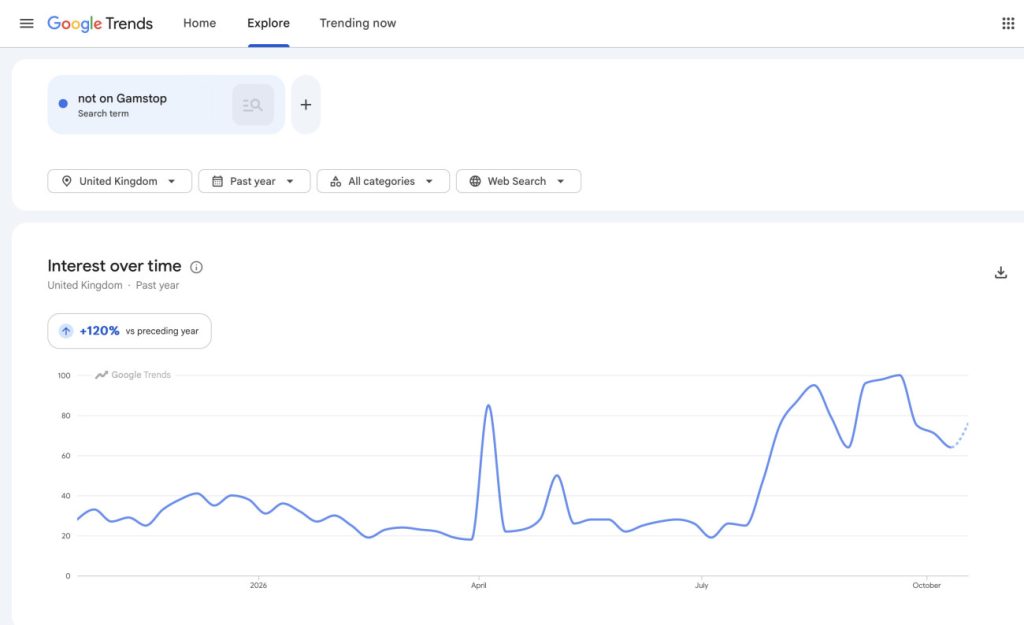
But with Google searches for ‘not on Gamstop’ up 120% YoY in the UK, efforts to tackle the normalisation of illegal gambling do not yet appear to have worked.