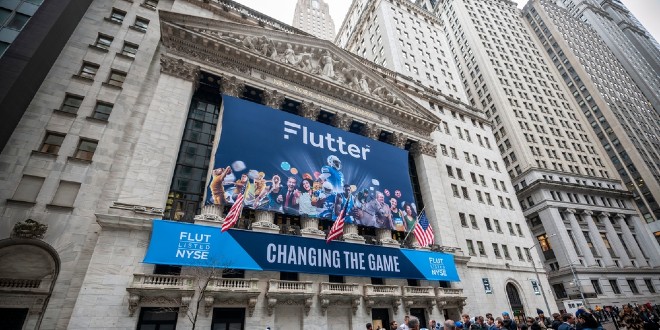
Flutter Entertainment has hit new lows on the New York Stock Exchange, as its stock dipped below the $70 mark for the first time this decade.
The gambling multinational, which is the biggest publicly-listed online operator in the world, continues to suffer a share price crisis with its market cap now dipping below $12bn (£9.1bn).
Flutter shares have fallen by a mammoth 69% in 2026 so far as a combination of industry-wide challenges plague the business, notably in key markets such as the UK and Ireland, the US and Australia.
They closed on Monday at $67.42 – the lowest price they have traded at since September 2014, when the company only comprised Paddy Power.
The latest blow comes as S&P Global downgrades its rating on the firm from ‘BB+’ to ‘BB’ due to increased competition in the US, higher investment needed for the development of FanDuel Predicts, as well as headwinds in the UK coupled with the betting ban now implemented in Brazil.
An industry-wide sell off in the US last week meant that Flutter was not the only firm suffering from tumbling share prices. Market leading rival DraftKings also experienced an unwanted milestone as its stock dropped under $16 for the first time since early 2023.
S&P Global now expects Flutter’s full-year adjusted EBITDA to come in at $1.5bn, before increasing to $2.2bn in 2027. Its own definition of adjusted EBITDA includes roughly $900m in expenses which Flutter excludes.
On a comparative basis, the financial and analytics giant actually expects Flutter’s adjusted EBITDA to come in slightly under the company’s own expectations of $2.495bn.
Why is Flutter’s share price continuing to dip?
The continued growth of prediction markets stateside is still eating away at analysts rating Flutter.
Kalshi suffered another blow in New York last week, as a federal judge sent New York Attorney General Letitia James’ $36bn unlicensed-gambling lawsuit back to state court and rejected the CFTC’s emergency bid to block it.
The company faced a pivotal hearing yesterday in which New York Supreme Court Justice Melissa Crane denied James’ bid to implement a temporary restraining order, though Kalshi has paused operations in Utah and the legal landscape is showing signs of a pathway to a return to growth for sportsbooks opening up in the US.
On the flip side, Kalshi recently raised a Series G funding round at a valuation of $40bn, while Polymarket’s valuation is also now in the multi-billions.
More challenges come in the form of tax rises in the UK, squeezing Flutter into 1,400 job cuts and a complete restructuring of its UK and Ireland business.
Leadership figures have consistently flipped negative noise around hikes in Remote Gaming Duty, General Betting Duty and Machine Games Duty, stating that it allows the business to increase market share for its Paddy Power, Betfair and Sky Bet brands.
This confidence has not been reflected in the market, however, with investors viewing any UK-focused operator as under the pump, as seen by share price dips for the likes of Rank Group and Entain.
A betting bet in Brazil added more unwanted pressure on Flutter at the end of September.
The ban, which is now not set to be lifted until at least March, curtails the firm’s Betnacional operations, which had become a key growth driver.
These headwinds have forced the company’s hand. Flutter announced in its Q3 results that it had paused its share buyback programme to “prioritise organic investment, deleveraging and cost-savings”.
A fifth successive quarter of downgraded expectations and a plethora of implemented mitigation measures do not spell positive signs for the group.
Despite this, the outlook still remains stable, and many other analysts still hold three-figure target prices.
But this new low represents a serious cause for concern for a business which investors have been waiting for a long time to return to growth on the public market.
S&P Global’s statement read: “The stable outlook reflects our view that Flutter can return to profitable growth, despite continuous investments in US prediction markets and regulatory headwinds in international markets reducing leverage below 5.0x and increasing FOCF (free operating cash flow) to debt above 5% by end-2027.
“It also reflects the group’s supportive financial policy with suspended share buybacks that, based on supportive adjusted FOCF of more than $700m from 2027, support lower S&P Global Ratings-adjusted debt levels.”