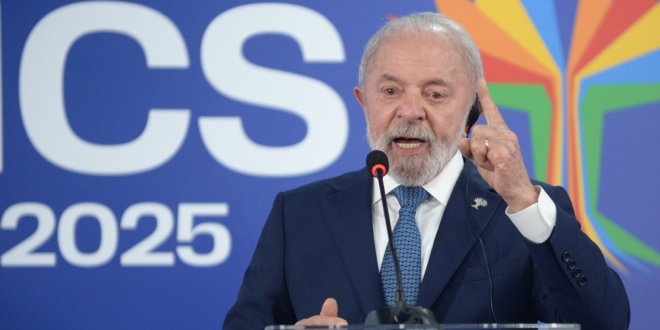

São Paulo Governor Tarcísio de Freitas calls on Brazil’s conservative blocs to support the prohibition of gambling as horse trading continues in an election year, reports Leonardo Biazzi, Editor of SBC Noticias Brazil.
Brazilian political rhetoric against the Bets Law continues to sour, increasingly pointing towards the most extreme conclusion for the framework that has governed online gambling since 2025 … that of full-repeal or full prohibition.
Tarcísio de Freitas, the Republicanos Governor of São Paulo seeking re-election as leader of Brazil’s richest state, is the latest pallbearer of the Bets Law. This week, SP governor dispensed with any niceties simply stating that “betting itself has to disappear”.
“It’s simple, either Brazil ends the bets, or the bets end Brazil,” de Freitas declared at a healthcare debate organised by SindHosp on 17 August. De Freitas compared gambling with Brazil’s “battle against smoking, warning that addiction could prove an even greater challenge.”
Prohibition based on fantasy evidence
His rhetoric is striking; yet his evidence appears to be fantasy. Governor De Freitas claimed that “between 20% and 25% of Brazilians’ income is committed to gambling”, a statement that is not backed by any current sources.
In his speech, he accused Bets licensees of raking in billions from the Brazilian public, unaware of the current loss-making status of market incumbents and making no distinction on deposits, turnover or actual losses – a common trait in current debate of online gambling in Brazil’s political blocs.
De Freitas has chosen to tie in gambling with his re-election campaign, linking wagering to decline in the productivity of the state. His proposed response includes an accessible mental-health programme in São Paulo should he win re-election. Increasingly, however, the Governor calls for Conservative camps to lead the prohibition of the Bets Law.
Launched in January 2025 to transition Brazil into a federally regulated online gambling market.
The Bets Law was supposed to replace a sprawling offshore market with licensed operators, taxation, consumer safeguards, advertising standards and federal oversight. Yet barely 20 months later, that settlement is under attack from both sides of Brazilian politics.
De Freitas, a leading conservative figure of Brazilian politics and highest profile of the Republicanos, now finds himself sharing ground with President Lula and the Workers’ Party (PT).
On 14 August, Lula declared: “If no one shows me a legitimate reason for these betting companies to continue, we have to put an end to them.”
Lula challenges Congress
In Congress, Lula on re-election mode has toughened his soapbox. The President has criticised opposition blocs of succumbing to a “powerful betting lobby” that is resistant to the PT government repealing the Bets Law.
The attacks are an awkward contradiction, that the President is fully aware of. His government inherited an unfinished regulatory project and transformed it into an operational market, establishing federal supervision and licensing on unfinished terms needed for a federal law.
Yet Lula now appears willing to contemplate repealing the very framework his administration implemented.
The PT has already moved in that direction. In April, party deputies introduced PL-1808/2026, seeking to repeal the Bets Law and prohibit fixed-odds betting. With Brazil voting on 4 October, gambling has achieved a rare political distinction: hostility from both left and right.
Yet prohibition presents a question neither camp has convincingly answered: what replaces regulation?
Removing licensed operators would not necessarily remove gambling. It could instead return consumers to precisely the grey market regulation was designed to eliminate, a warning often reiterated to the PT government.
The Treasury has become a considerable beneficiary of regulation. Figures from the Receita Federal, Brazil’s tax and customers agency, show that betting generated R$3.1bn (€490m) in federal tax receipts between January-April 2026, following roughly R$9bn collected during 2025.
Meanwhile, Serie A football clubs, broadcasters and sporting organisations have become commercially entwined with betting sponsorships. The Brazilian Football Confederation has warned against repealing the Bets Law.
None of this makes concerns about gambling imaginary. Addiction, household finances, advertising and youth exposure warrant scrutiny.
With many outstanding liabilities yet to be settled (consumer rights, advertising, safer gambling protections) the Bets Law regime is a failed system incapable of addressing them and will struggle to retain political legitimacy.
But prohibition requires something more substantial than campaign slogans and unreferenced statistics. Brazil spent years deciding how to bring a vast offshore market under state control.
Less than two years after regulation began, in Congress political blocs are contemplating abandoning the experiment, that has turned toxic under the election spotlight.
As October approaches, ending betting is becoming an unusually convenient campaign message for populist camps. Explaining how prohibition would actually stop the Brazilian public from gambling is rather less convenient and a reality no party wants to confront.
.