Last week’s inaugural SOFTSWISS Tech Race Summit in Warsaw proved there is a major appetite to keep building lasting relationships between tech and gambling.
With SBC News present to witness it all, we will share some of the most valuable insights on leadership and success in the digital age that innovators from both sectors revealed to the audience – starting with SOFTSWISS Founder Ivan Montik.
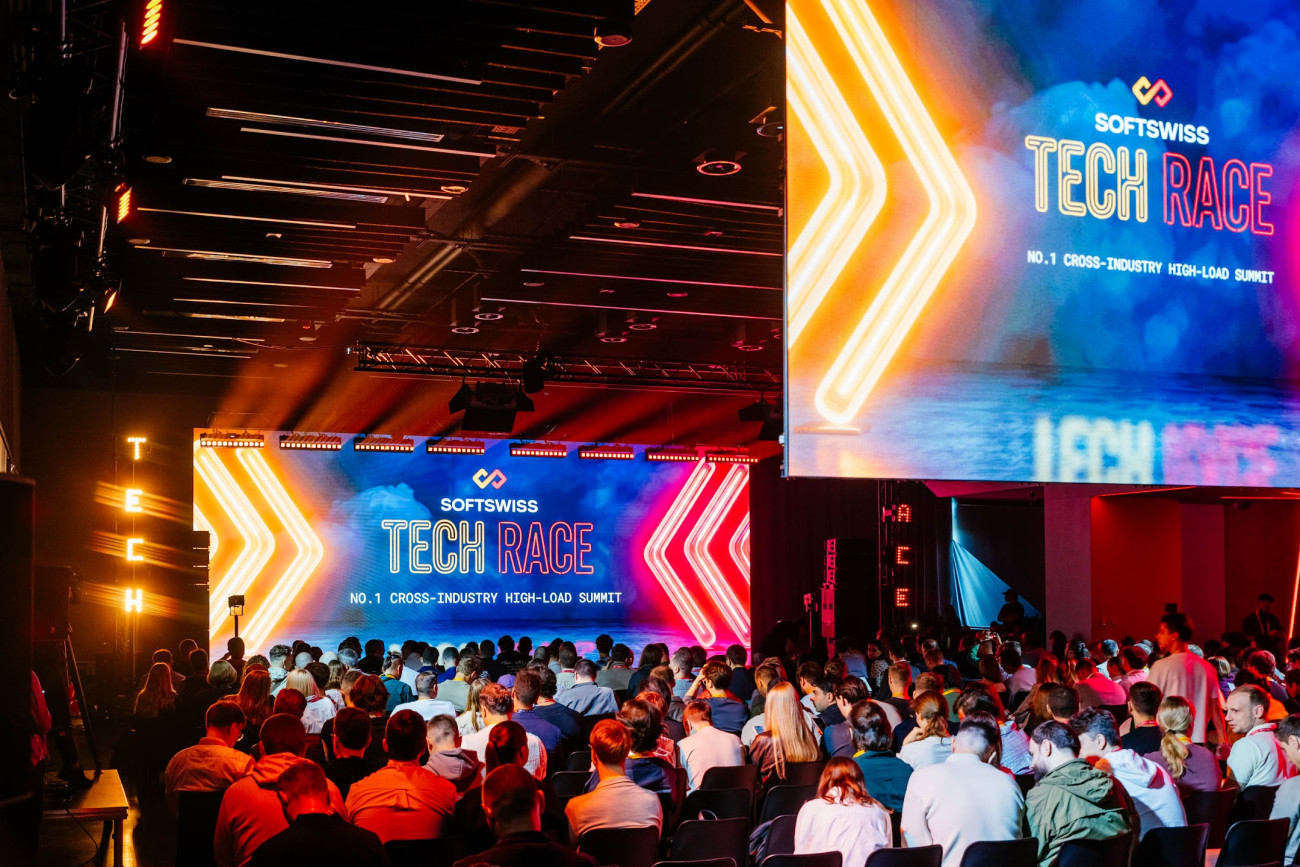
Walking up to the all-glass event venue at the modern Koneser Business Center in the heart of Warsaw, expectations were instantly raised for a fast-paced, tech-driven conference.
Landing a seat at the front of the stage in the main hall pushed the immersion even further. On either side of the stage, two vertical stacks of lights – deliberately echoing the ‘Christmas Tree’ starting lights of a drag race – spelled out ‘Tech’ and ‘Race’, underlining the event’s theme.
As the room plunged into darkness, laser-like lights began dancing across the screen to the pulse of an energetic club track, creating the illusion that the Tech Race Summit logo was being engraved in real time right in front of the audience.
It was a first impression that lingered long after the event concluded, and perfectly set the stage for the day’s opening speaker – Ivan Montik, Founder of SOFTSWISS.
Not everything is about tech anymore
Despite the high-energy opening and the event’s name, Montik turned the premise on its head within seconds of taking the stage:
“The real tech race is not won solely by technology anymore. It is won by the speed of execution and decision-making.”
Having founded or helped co-found four companies over the past two decades, Montik has experienced that evolution first-hand.
Perhaps technology was what helped SOFTSWISS pull away from the competition when it was first founded in 2009. But in today’s AI-driven age where powerful tools are at the fingertips of almost anyone, access to technology is no longer the bottleneck. The real difference lies in how quickly it can be put into action.
“What lets some companies adapt faster and others not? It is the flexibility of the management structures, how you approach your teams and how fast you, as a visionary, can take decisions,” Montik said.
“Today, without fast decisions, you can’t do business anymore.”
Now or never
In the business world, where cut-throat competition is constantly breathing down your neck, ‘fast’ generally translates to instantaneous. Neither the gambling nor tech sectors are an exception to this rule.
The arrival of AI has only shortened that timeframe. If your competitors can harness the technology available today more efficiently than you, the window to capitalise on an opportunity can now close faster than ever before, potentially resulting in a rapid decline in market share.
Montik’s advice on how to avoid this couldn’t be clearer: “In order to avoid this, you and your team need to learn to make really fast decisions. Not tomorrow, not next week.
“Today, and right now.”
And of course, some decisions will fail. But in Montik’s view, the alternative – watching someone else make the same move successfully – can be far worse.
“Technology alone doesn’t create value anymore. Decisions do.”
Speed as part of the company’s structure
To make the most out of your business capacity and deliver at speed, speed itself cannot be an afterthought. Instead, Montik views it as something that needs to be built into the company’s organisational structure from the outset.
In practice, particularly for companies with hundreds or even thousands of employees, this means breaking down the management chain into tightly knit groups of no more than 10 people.
The result is a more flexible structure that can retain and effectively disseminate information passed down from the top, while giving each group clear decision-making ownership. In Montik’s experience, this creates faster decisions by eliminating the need to work through multiple layers of management.
SOFTSWISS has already tried and tested this approach through the implementation of AI across its business. The company identified an issue where AI tools were being used by different teams, but without a clear structure in place to ensure they delivered the required results.
To tackle this, the management layer responsible for AI adoption was split into two main verticals. The Chief Technology Officer became responsible for security and innovation, while a Chief AI Officer oversaw the integration of AI tools across all SOFTSWISS teams.
One year later, each team now has an AI-adept member responsible for identifying how new technologies can be applied to its specific needs and using them to improve performance against team KPIs. The result, according to SOFTSWISS, is a clearer structure for AI adoption and more efficient use of the technology across the business.
Speed is king, but security protects the kingdom
Montik’s final point hit the brakes on the discussion around the speed of today’s tech race, shifting the focus to something businesses cannot compromise on – security.
Chasing rapid growth through an increasingly fast product delivery chain can only go so far without a robust security framework built around it. Industry leaders need to recognise that the same AI tools available to them can also be used by malicious actors, allowing them to exploit vulnerabilities and cause significant damage.
Montik knows this from experience.
After experiencing several years of explosive growth, CoinsPaid, the blockchain payment infrastructure company he helped co-found, was targeted by the Lazarus Group – a North Korean cybercrime syndicate.
On a Friday afternoon, the company lost $37.3m in what became a defining moment for its approach to security.
What followed were sleepless nights and a fundamental change in philosophy: learning from past mistakes and implementing ‘security by design’. In practice, this meant putting security at the forefront of decision-making across the company, from technology to HR.
Lazarus tried again several years later, but by then CoinsPaid had completely revamped its approach to security.
“My advice to you is to never sacrifice resilience for fast growth. Believe me.”
So what is the real tech race?
If we need to summarise Montik’s keynote speech, it is that winning the tech race of today is not simply about having access to the fastest technology. It is primarily about implementing the right structures to act on it.
This means having the confidence to make quick decisions before the opportunity disappears, alongside the resilience needed to protect what you have already built.
Perhaps the modern tech race is not about beating the competition after all, but racing against the clock to turn an idea into action without compromising the foundations that keep a business moving forward.