 In the third and final article about how businesses are using Google+, SBC’s Sam Cooke compares the network against Facebook and asks why bookmakers are not making more headway. Read part 1 here and part 2 here.
Google+ vs Facebook
Were we speaking in terms of purely which is the more ‘social’ network; that is keeping in touch with friends and family, Facebook wins hands down. However if we were to consider an online social platform in terms of connecting with those with similar interests, and establishing a network of these people, especially in terms of usefulness for brands then Google+ is not so far off.
In terms of promoting a business or brand the battle rages between Facebook fan pages and Google+. Facebook has significantly more active users, and moreover, users who spend more time on average on the site than they do Google+. A report from Mashable found that in March 2013 users spent, on average, just under seven minutes on Google+ compared to six hours and fourty-four minutes on Facebook. There is some respite for Google in the knowledge that since the previous year’s report their figure rose from 3.3 minutes whilst Facebook’s dropped from seven hours and nine minutes. How much weight we can give to these figures is debatable, especially in terms of brand interest, as how much of that time was spent stalking friends’ photos and playing games is unfathomable. Though the vast difference certainly counts for something.
As such, should a brand’s priority be aiming to promote awareness; Facebook remains the ideal option. However, as a layer of Google itself, and with the Google Adwords function, attempting to directly sell a product could be better suited to Google+.
With the recent feature of +Posts the case for Google+ is strengthened and this could also near level the playing field of which is the superior platform for raising brand awareness. Importantly, in a study which took in six months of date from September 2013 to February 2014, it was discovered that Google+ was superior to Facebook in terms of engagement with social referrals. That is to say Google+ users spend more time on the links they click through to than those on Facebook. This is a fact that brands should not ignore.
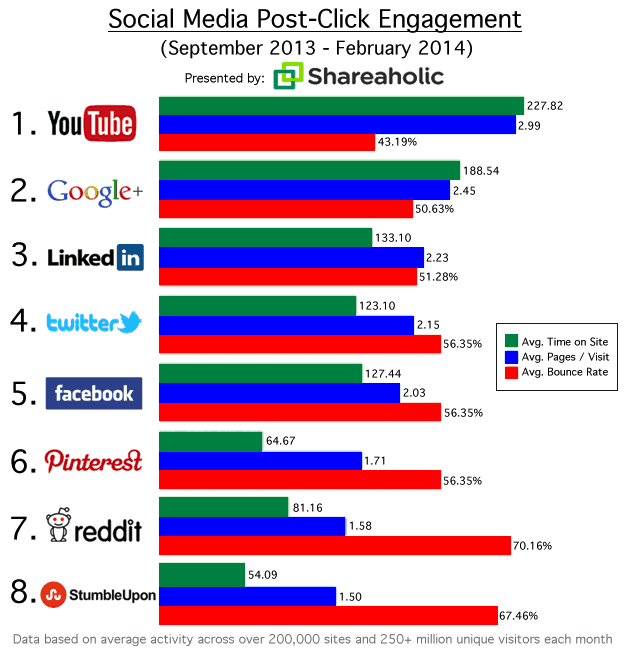
In another study it was found that Google+ only very narrowly fell behind Facebook in terms of engagement with brand’s posts, in fact they were at essentially the same percentage.

Ultimately, in a world where you do not need to choose a side (yet at least…) brands should have a presence on both Facebook and Google+.
Gambling industry and it’s lack of interest
The gambling and betting industry is one which has yet to make much headway into embracing the world of Google+.
 Of the top bookmakers William Hill and Ladbrokes are the only ones to maintain a notable presence. Despite a lack of regular updates, William Hill have managed to accumulate 904 followers with 707,139 views whilst Ladbrokes can count 539 followers and 148,653 views. This many page views despite a poor showing in terms of followers surely highlights the potential gravy train for driving traffic that is Google+. Outside of these two, the lack of showing from social media kings Paddy Power is surprising, whilst the rest are largely, and somewhat inexplicably, void of a Google+ page.
Football and Google+ have worked together effectively in the past with campaigns such as Manchester United’s ‘Front Row’ story. Using the Hangouts features, fans from all over the globe were broadcast live at a match against Liverpool showing their support. Another campaign, exclusively on the platform hosted by Real Madrid, and entitled ‘Fans for Real’, offered fans the chance to win a prize which would mean being flown to Madrid to watch the team practise. Fans were asked to +1 both Real Madrid and the Emirates on Google+, and upload engaging content.
The Hangout feature was used by William Hill in a campaign last year called #askSavage in which fans were able to pose questions to the player turned pundit. This feature seems ideal for promotional purposes for bookmakers with the likes of Scholes and Joey Barton already on the Paddy Power team. At Bet365 there’s Ray Winstone whilst newcomer 666Bet have Harry Redknapp on board. All of these would make for highly popular Google+ Hangouts. It is surely just a matter of time before the platform stops being overlooked by this particular industry.
The future
There have been many touting the imminent death of Google+, amidst rumours of the ending of the highly unpopular forced integration with Youtube and other Google services. This move to unify all of Google gave the company the opportunity to collect even more user data, to collate it and analyse user behaviour across its services. In turn this, Google stated, meant a more personalised search engine and a better experience for each user. Of course it also meant a far improved ability for target audience advertising, as better than ever before they were aware of user’s habits, locations and personal information.
Google+ is in a period of transition and will doubtless transform itself in the near future. Be rest assured however, that its usefulness for businesses will not fade. If anything it will strengthen. In 2013 alone, two trillion Google searches are testament to that. In just three years it’s come a long way (whilst perhaps not initially at the rate expected) in taking on the major players of Facebook and Twitter.
Carrie Kerpen, of Likeable Local, a Facebook marketing agency, said of the platform: “Google+ is really important because of search purposes. Google holds the keys to search, so if you want to be found on Google you need to get active on Google+.”
“Don’t fall asleep on Google+,” she added.
It may have lay dormant for the first year or so but Google+ is now wide awake and it has a very important role to play in the future of online marketing. The sooner more companies realise and act upon this information, the better they’ll fare.









Feel positive about Google+: Part 3 – The Future
You’ve shared it!
Google+ vs Facebook
Were we speaking in terms of purely which is the more ‘social’ network; that is keeping in touch with friends and family, Facebook wins hands down. However if we were to consider an online social platform in terms of connecting with those with similar interests, and establishing a network of these people, especially in terms of usefulness for brands then Google+ is not so far off.
In terms of promoting a business or brand the battle rages between Facebook fan pages and Google+. Facebook has significantly more active users, and moreover, users who spend more time on average on the site than they do Google+. A report from Mashable found that in March 2013 users spent, on average, just under seven minutes on Google+ compared to six hours and fourty-four minutes on Facebook. There is some respite for Google in the knowledge that since the previous year’s report their figure rose from 3.3 minutes whilst Facebook’s dropped from seven hours and nine minutes. How much weight we can give to these figures is debatable, especially in terms of brand interest, as how much of that time was spent stalking friends’ photos and playing games is unfathomable. Though the vast difference certainly counts for something.
As such, should a brand’s priority be aiming to promote awareness; Facebook remains the ideal option. However, as a layer of Google itself, and with the Google Adwords function, attempting to directly sell a product could be better suited to Google+.
With the recent feature of +Posts the case for Google+ is strengthened and this could also near level the playing field of which is the superior platform for raising brand awareness. Importantly, in a study which took in six months of date from September 2013 to February 2014, it was discovered that Google+ was superior to Facebook in terms of engagement with social referrals. That is to say Google+ users spend more time on the links they click through to than those on Facebook. This is a fact that brands should not ignore.
In another study it was found that Google+ only very narrowly fell behind Facebook in terms of engagement with brand’s posts, in fact they were at essentially the same percentage.
Ultimately, in a world where you do not need to choose a side (yet at least…) brands should have a presence on both Facebook and Google+.
Gambling industry and it’s lack of interest
The gambling and betting industry is one which has yet to make much headway into embracing the world of Google+.
Football and Google+ have worked together effectively in the past with campaigns such as Manchester United’s ‘Front Row’ story. Using the Hangouts features, fans from all over the globe were broadcast live at a match against Liverpool showing their support. Another campaign, exclusively on the platform hosted by Real Madrid, and entitled ‘Fans for Real’, offered fans the chance to win a prize which would mean being flown to Madrid to watch the team practise. Fans were asked to +1 both Real Madrid and the Emirates on Google+, and upload engaging content.
The Hangout feature was used by William Hill in a campaign last year called #askSavage in which fans were able to pose questions to the player turned pundit. This feature seems ideal for promotional purposes for bookmakers with the likes of Scholes and Joey Barton already on the Paddy Power team. At Bet365 there’s Ray Winstone whilst newcomer 666Bet have Harry Redknapp on board. All of these would make for highly popular Google+ Hangouts. It is surely just a matter of time before the platform stops being overlooked by this particular industry.
The future
There have been many touting the imminent death of Google+, amidst rumours of the ending of the highly unpopular forced integration with Youtube and other Google services. This move to unify all of Google gave the company the opportunity to collect even more user data, to collate it and analyse user behaviour across its services. In turn this, Google stated, meant a more personalised search engine and a better experience for each user. Of course it also meant a far improved ability for target audience advertising, as better than ever before they were aware of user’s habits, locations and personal information.
Google+ is in a period of transition and will doubtless transform itself in the near future. Be rest assured however, that its usefulness for businesses will not fade. If anything it will strengthen. In 2013 alone, two trillion Google searches are testament to that. In just three years it’s come a long way (whilst perhaps not initially at the rate expected) in taking on the major players of Facebook and Twitter.
Carrie Kerpen, of Likeable Local, a Facebook marketing agency, said of the platform: “Google+ is really important because of search purposes. Google holds the keys to search, so if you want to be found on Google you need to get active on Google+.”
“Don’t fall asleep on Google+,” she added.
It may have lay dormant for the first year or so but Google+ is now wide awake and it has a very important role to play in the future of online marketing. The sooner more companies realise and act upon this information, the better they’ll fare.