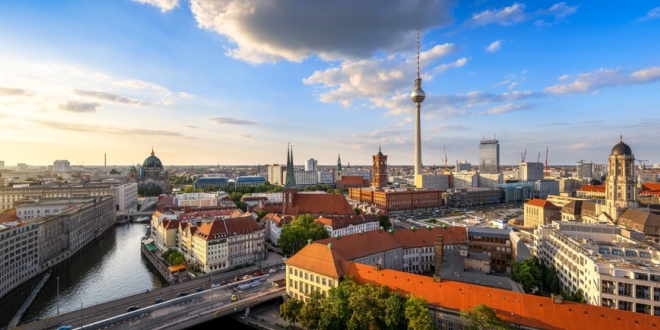
Germany stands out as a double edged sword in European iGaming, being similarly one of the most high value and growth potential markets while also being one of the most challenging, particularly from a regulatory standpoint.
Black market threats, the difficulty of competition, high taxes and strict regulatory requirements are likely on everyone’s agenda today at the 2025 Gaming in Germany conference in Berlin – where SBC News’ Senior Journalist, Viktor Kayed, is reporting live on the ground.
Join us, as our live coverage starts at 09:00 GMT / 10:00 local time, with the opening words of Sebastian Buchholz, Head of Licensing and Market Supervision, at Germany’s regulator – Gemeinsame Glücksspielbehörde der Länder (GGL).
Sessions will continue throughout the day, with the concluding panel starting at 16:00 GMT. You can find the full agenda here.
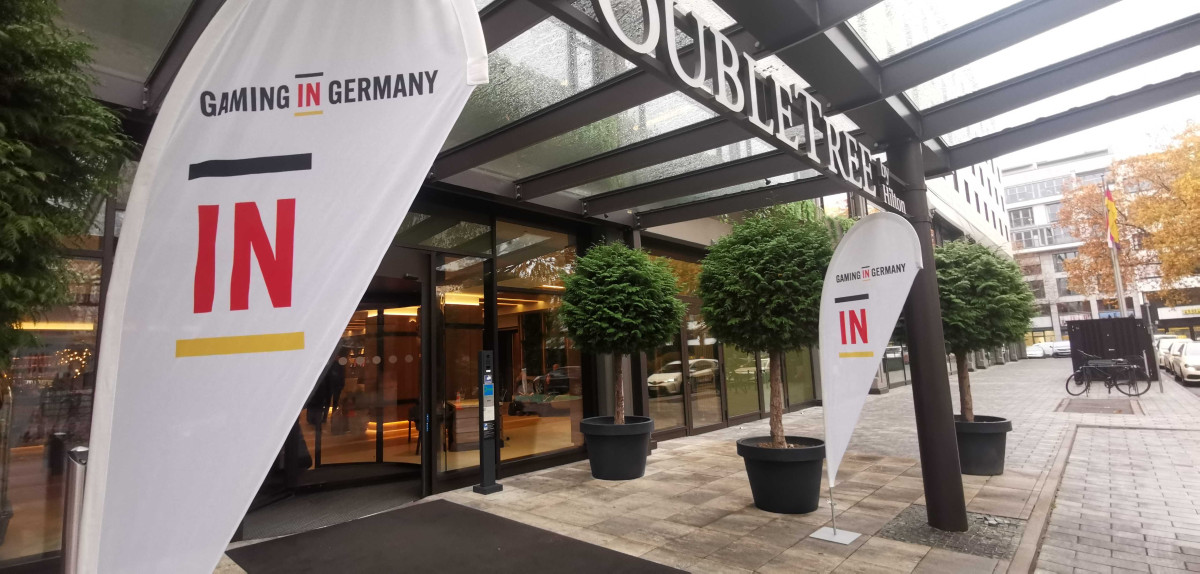
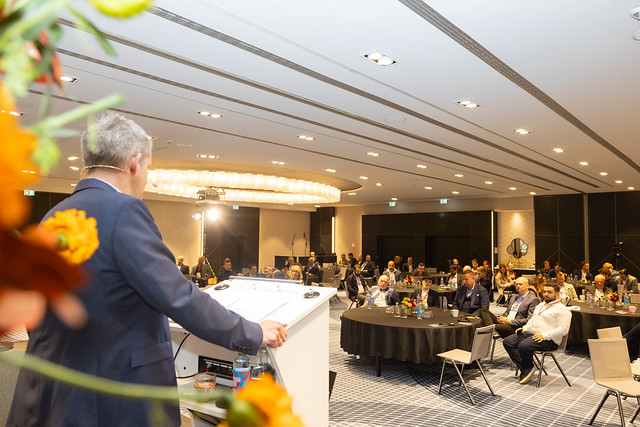
Photo taken by Viktor Kayed
09:20 – Ready to go
Stakeholders from across Germany’s betting and gaming sector are ready and waiting for the opening remarks from Sebastian Buchholz, Head of Licensing and Market Supervision at the GGL, whose observations on how the German market has developed since the 2021 federal regulation will be of interest to many.
10:05 – Claiming back player safety
Kicking off today’s conference is Sebastian Buchholz, Head of Licensing and Market Supervision at the German regulator GGL.
Buchholz expressed satisfaction with the work the GGL has done throughout the recent years in terms of fighting the black market, with “thousands” of illegal websites chased down and identified.
On the other hand, he recognised that there is still much work to be done to protect German players. A lever that the GGL acknowledged could be instrumental in “claiming back the safety of German players” are the recently-introduced markers of harm by the European Gaming and Betting Association (EGBA).
Online market channelisation rates was another area that the GGL specifically expressed commitment to continue investigating more closely.
Lastly, Buchholz called for an evidence-based approach towards the ongoing evaluation of the current national gambling framework – expected to conclude by the end of 2026.
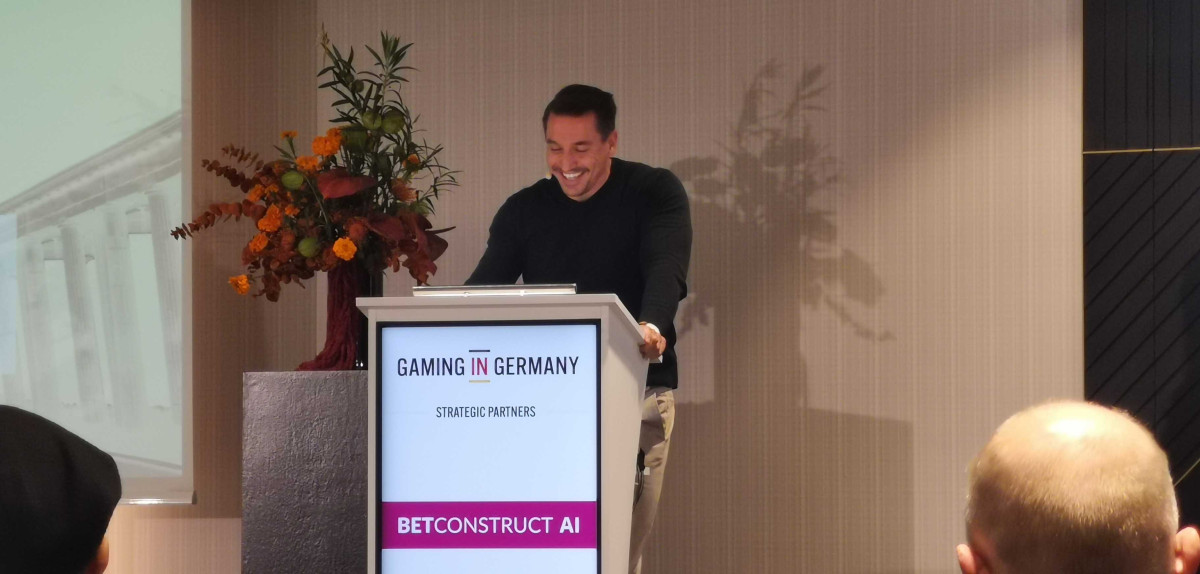
Sebastian Buchholz, GGL – photo taken by Viktor Kayed
10:45 – “Germany is paralysed to death”
Buchholz’s remarks were followed up by a somewhat somber view of the German virtual slots market, provided by Dr Dirk Quermann, President of the Deutscher Online Casinoverbrand (DOCV).
Quermann said that the ongoing evaluation of the 2021 State Treaty on Gambling (GlüStV) needs to address the issue of overregulation – and that the virtual slots market is in dire need of a change.
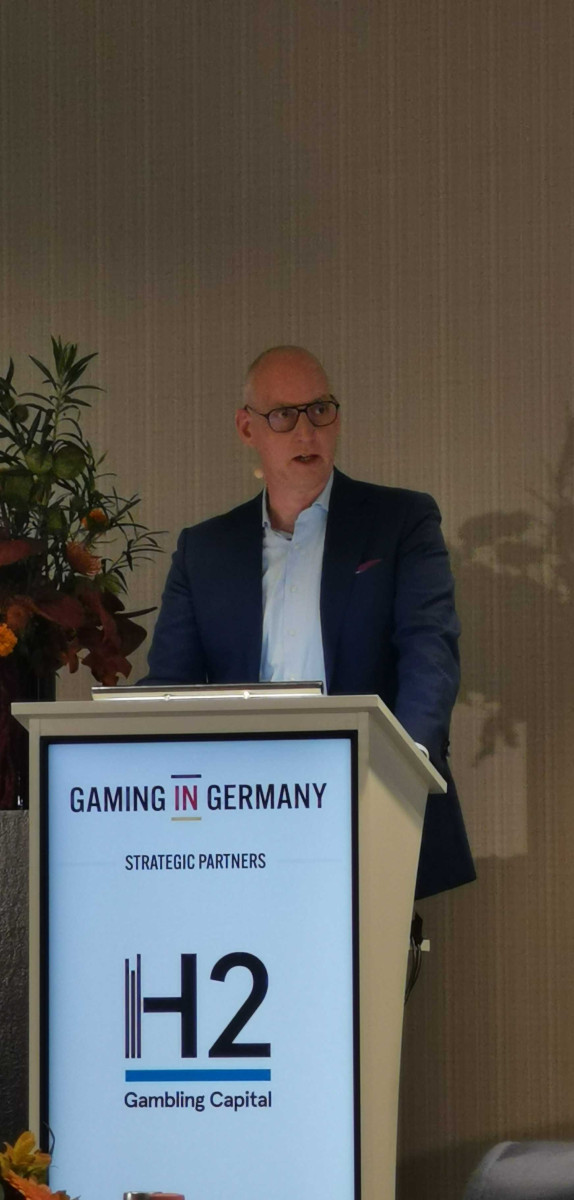
Dr Dirk Quermann, DOCV – photo taken by Viktor Kayed
According to the DOCV President, effective change will only happen when the GGL is left to work on its own accord and federal states lessen their influence. This would help the regulator transition from “a gatekeeper to an architect” in its decision-making.
“We need to get out of this situation, where federal states exert influence on the authority.”
Another key point was that the currnt regime is currently taxing wagers at 5.3% per play rather than having a GGR-based taxation system in place as in most European jurisdictions.
This is “counter-productive” and actually leads to fewer taxes generated in federal states, Quermann added.
“Taxation is a real trap. It is one of the main reasons for the market to be almost paralysed to death. All EU markets have a positive channelisation growth unlike Germany, for the reasons I just mentioned,” he concluded.
11:05 – The black market is winning in the first half
The German sports betting market is not much different from its online slots counterpart.
Mathias Dahms, President of the Deutscher Sportwettenverband (DSWV), said that the situation is “really depressive”, to be exact.
When it comes to sports betting, Dahms likened the legal market’s fight against black market operators to a football match, where the result is currently 1:11 for the wrong side.
This is due to there being “11 times more illegal sports betting providers” than legal ones, Dahms added.
As a reminder, the total value of licensed bets was reported at €3.22bn in Q2, down from the €3.5bn in Q1.
To protect the German market’s long-term sustainability, the DSWV said that the actual size of the black market needs to be truly recognised.
The estimates of both the DSWV and the GGL differ wildly, with the former arguing that illegal online gambling takes between 30-40% share of players against the 25% estimate by the latter.
Dahmer then proposed a four-step strategy for the “second half of the match” – increase the spending limits, give the GlüStV evaluation a channelisation focus, tighten collaboration between all shareholders, and remove the bureaucracy from sports betting.
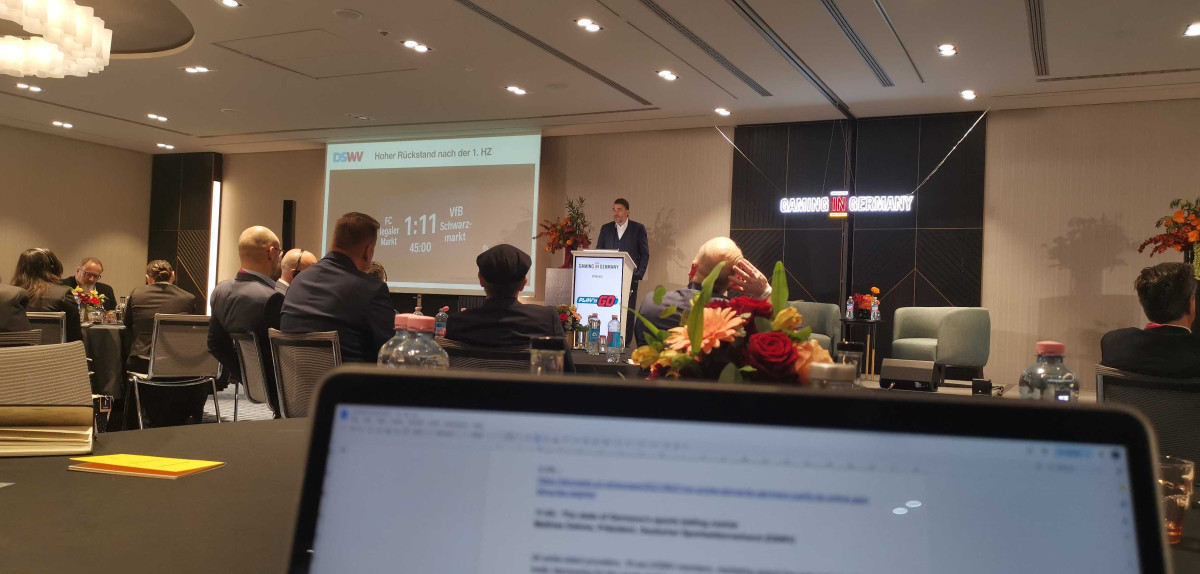
Mathias Dahms, DSWV – photo taken by Viktor Kayed
11:50 – “Essentially all models are wrong, but some are useful”
Josh Hodgson, COO of H2 Gambling Capital, crunched the most important numbers of the day, starting off with an interesting quote by statistician George Box. That is “essentially all models are wrong, but some are useful.”
After the panel’s conclusion, it appeared as if Germany is a physical manifestation of that statement.
Hodgson highlighted the difficulty of evaluating the growth of Germany’s online gaming market due to conflicting reports from both its Ministry of Finance and the GGL.
The latter – calculating based on tax receipts – reported that the market is shrinking, while the GGL reported the opposite, essentially leading to “neither GGL or the Ministry of Finance giving us a definite answer on Germany’s onshore online market,” in Hodgson’s view.
According to H2’s data, it was only until 2024 when both organisations aligned in their estimates, with “no reliable source” to track the onshore market size prior to that.
However, by analysing all data, H2 revealed that the onshore market’s performance has effectively declined from a point of regulation.
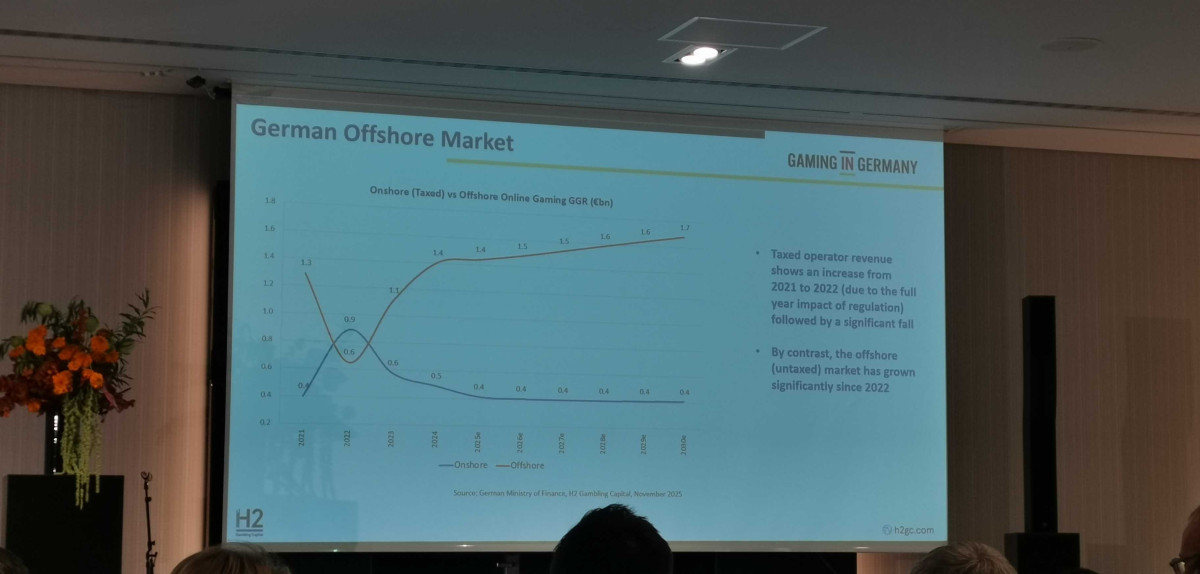
Photo taken by Viktor Kayed
Hodgson’s estimates placed Germany’s current online market channelisation rates at between 22% and 25%, with predictions being for a rate as low as 20% by 2030. This aligns more closely to the DSWV estimates mentioned previously than the GGL’s.
Market attractiveness does play a key role in that decline. H2 raised the question about online stake limits in Germany, which are currently placed at €1.
Bringing up the UK as an example, where the stake limit was set at £5, Hodgson said that at the time of implementation earlier in April, 22% of slot stakes exceeded that limit. H2 now expects this to “disproportionately impact high-spend players” and drive them to the black market.
For Germany, Hodgson expects the impact to be much more severe given the lower stake limit threshold. “Restrictions are preventing the onshore to compete with its offshore counterparts,” he concluded.
We’re stepping back for a quick lunch break. Make sure to stick around as we return with our in-depth coverage shortly.
14:00 – Regulators should focus on their remit
Coffee flows like a river here at Hilton DoubleTree in Berlin, but this is understandable given the grasp of topics still on the agenda.
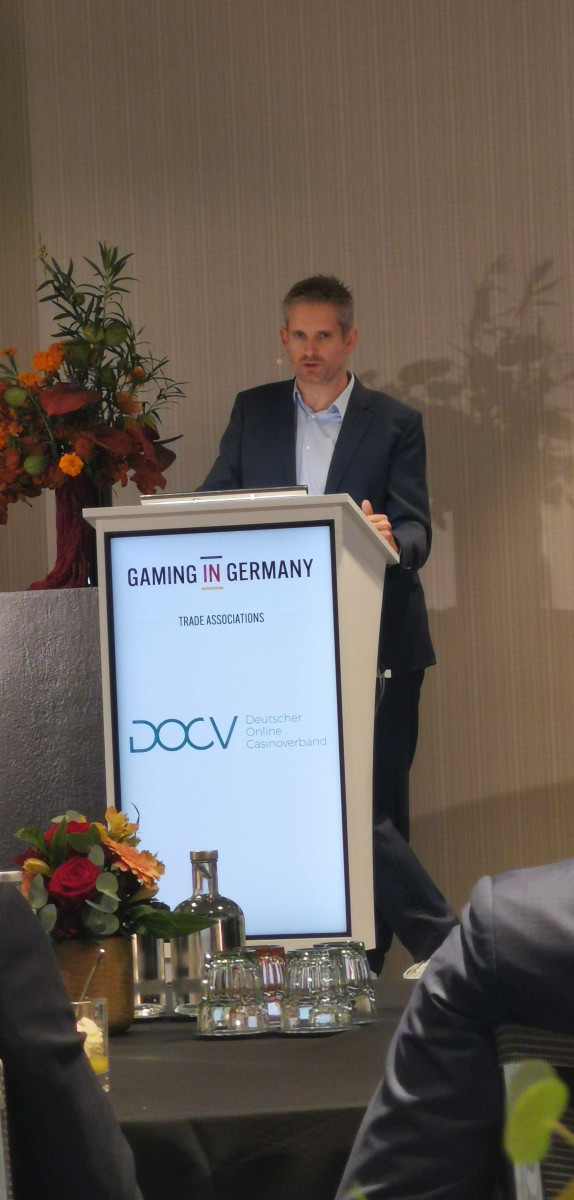
Ewout Keuleers, IBIA – photo taken by Viktor Kayed
Next up, Ewout Keuleers, who is a former General Counsel at Kindred Group and current Chair at the International Betting Integrity Association (IBIA), offered a different perspective on the black market.
His belief was that fighting against the black market, not only in Germany but in all other regulated markets, can gain leverage by focusing the debate more on what the player wants.
Regulators, Keuleers said, are purely administrative authorities that cannot rise against international crime networks on the other side of the world – that’s under the remit of criminal law enforcement.
As administrative authorities, they instead should focus on players having a high quality offer. The starting point of every black market debate should be what the player wants in terms of technology and choice, Keuleers added.
“How far do you want to restrict freedom of choice to protect all customers, if possible at all,” was one of the rhetorical questions he addressed the audience with.
“Yes there is a black market, yes there is a problem, but as long as we’re seen as part of the problem and not the solution, no one will care about what we do and what our intentions are, especially in the political context. This is the real problem we have as an industry.”
14:20 – Big results with big tech
Next up, Christian Heins, Director of iGaming at Tipico, visualized what licensed operators in Germany can do to hit the black market where it hurts the most – advertising.
Tipico itself utilises publicly accessible marketing databases on big tech platforms like Meta and Google to seek and identify illicit advertising campaigns, after which it checks with GGL’s whitelist and reports its findings not only to the regulator, but also to the tech platform.
While Heins said that there’s still more to be desired from Meta, Tipico’s collaboration with Google on the other hand can safely be called a “good example of what operators can do” in terms of orchestrating a meaningful collaboration between big tech, regulators, and the industry.
Thanks to Tipico’s continuous monitoring of Google’s search algorithms, illegal pay-per-click adverts on the platform shown to German consumers have fallen by 99% – from 97k in Q3 2024 to just 858 in Q3 2025.
However, Heins added that VPN usage still remains an Achilles heel for the German regulated market, and that the sector shouldn’t be surprised when “players get preyed upon” in the aftermath.
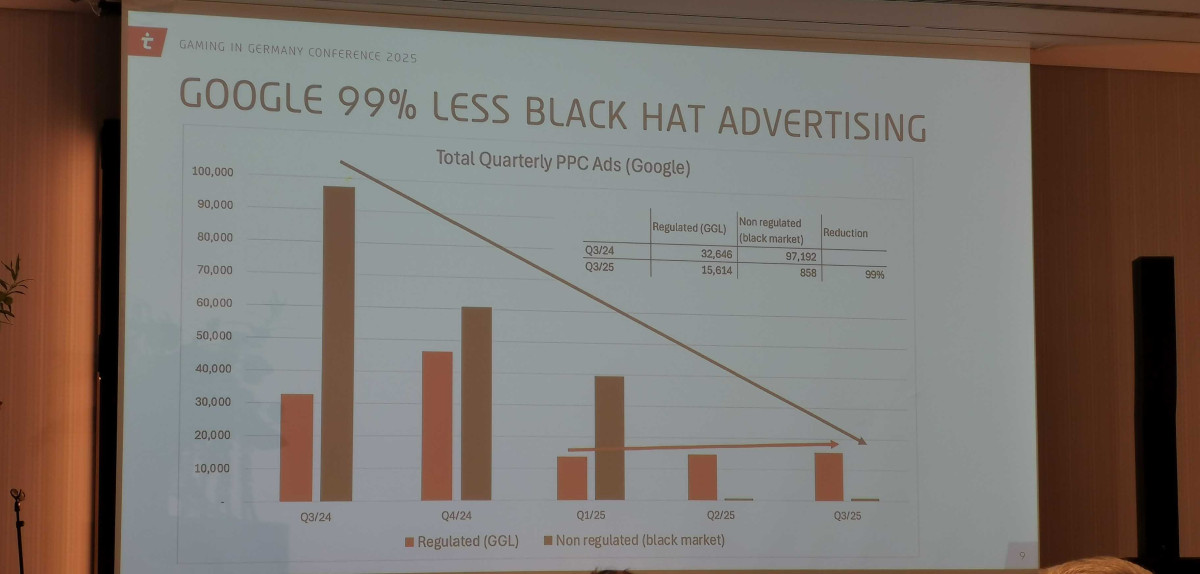
Photo taken by Viktor Kayed
16:05 – What does the German player want?
Back to the point of the conversation being shifted to what the player wants, Alex Green, Vice President of Games at ZEAL Network, clearly outlined what these wants are.
With the German-based lottery games provider active internationally, Green leveraged ZEAL’s global experience to give direct examples of what players are expecting from operators – regardless whether it’s lotteries, betting, or iGaming.
First and foremost, customers would appreciate it if they won more regularly, which Green said is entirely possible in Germany given that it is known what the black market is offering in terms of RTP, and the current tax regime being perhaps the main obstacle for licensed operators to match that.
Convenience was placed second, with Green pointing out that players currently require separate wallets for lotteries and online games. Imagine going to the shoe store and needing two wallets for boots and sneakers, he added.
Thirdly, choice and innovation are also among the areas that players tend to prioritise. Choice for slot games in Germany is high, Green added, but the choice of digital instant games is limited for those who prefer offerings other than slot games.
The last point raised by Green was that players expect to be updated on upcoming games. In Germany, this is currently a challenge, he added, because of the GGL’s games approval model being somewhat slow and in need of a revision.
16:25 – Germany is lagging behind Europe
One of the biggest trade associations in Europe, the European Gaming and Betting Authority (EGBA), also made an appearance in Berlin.
Maarten Haijer, EGBA President, started off on a positive note, saying that EGBA and its members generally embrace regulation as a principle that helps them distinguish themselves from the black market.
Haijer also praised Germany as a “very good example” of marketing clampdown on black market advertising, as previously pointed out by Tipico. However, this is where the praise ended.
“There’s still room for improvement,” Haijer said. “Compared to other countries in the EU, it is difficult for Germany to move forward based on the discussions we had today.”
According to EGBA’s President, Germany is currently doing the least well compared to its European counterparts because of how it has organised its iGaming regulation.
“We’ve seen from experience that measures like horizontal deposit limits and advertising restrictions do not have the desired effect.”
Still, deciding to remain optimistic, Haijer added that associations like EGBA do have the power to change the course of history, as the industry has all the data needed to showcase what works and what doesn’t.
“We have the ability to bridge the knowledge gap of black market data between operators and regulators. We just need to do it more.”
Haijer was also asked if a harmonised online gambling framework in Europe is on the horizon, to which he added that it’s not happening soon. His full views on the latter had previously been shared exclusively with SBC News.
16:45 – Right-wing politics as double-edged sword
We can’t talk about regulations without mentioning politics as well. Julia Lensing, Partner, Public Affairs at von Beust & Coll, reminded the audience that Germany has five Länder elections coming up next year, including in the GGL’s home of Saxony-Anhalt.
However, right-wing semantics are growing more popular not only in Europe but also in Germany, and next year’s results could prove a double-edged sword for gambling regulations.
Time will tell for certain, but one thing became evident – unlike elsewhere in Europe like in Finland and Scandinavia, today there wasn’t a single Länder representative in the conference room at Gaming in Germany.
17:00 – What’s on Germany’s Christmas wishlist?
Closing the conference on a high note, stakeholders were again invited on stage for a “speed dating” type of conversation, where they were given three minutes each to again state what they would most like to see over the next 12 months.
Dirk Quermann, Deutscher Online Casinoverband (DOCV), wished for a more favourable online gambling tax environment within the next year.
Luka Andric, Chief Executive, Deutscher Sportwettenverband (DSWV), called for better use and more acknowledgement of industry data to positively develop the German market.
Christian Heins, Director iGaming, Tipico, named three numbers – six, 36, and 78. These represented Euro per capita generated in 2024 from licensed casino operators – the first from Germany, the second from the Netherlands, and the third from Denmark. “Learn from that,” Heins added.
Next up was Kevin O’Neal, Senior Strategist Germany at Kaizen Gaming, who wished for Germany to become one of the positive examples where regulations improve.
Lastly, Alex Green, VP of Games at ZEAL Network, called for “more logic and pragmatism when moving to reclaim the market.”
This concludes our live coverage of the Gaming in Germany 2025 conference in Berlin.